AUTHOR SITE
Books and short reads on Prehistory and Astronomy

A journey through the ages of humanity, from the first apes to the first cities. The From the Beginning series of books and short reads explores human evolution, archaeology, and the prehistoric world.
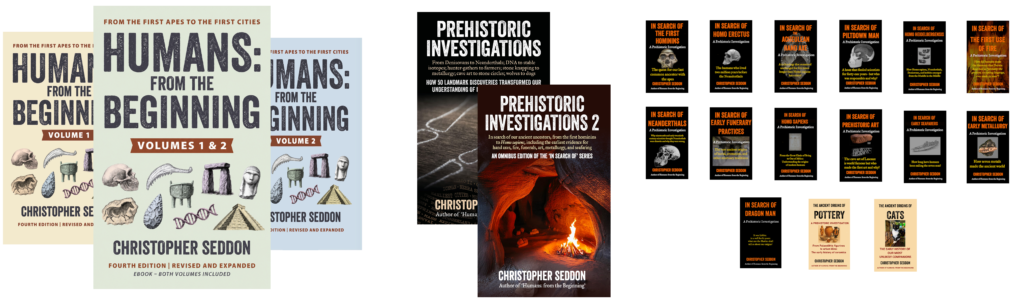
The 50-chapter Prehistoric Investigations is intended as an accessible introduction to many of the most fascinating questions in prehistory and human evolution. It explores a wide range of topics, including Neanderthals and Denisovans, radiocarbon dating, ancient DNA, temples and settlements of the Early Neolithic period, how our ancestors domesticated cats and dogs, the origins of the Indo-European languages, the fate of Ötzi the Iceman, the enigmatic Nebra sky disc, and the invention of writing.
Prehistoric Investigations 2 is an omnibus of twelve eBook 12,000-word short reads, all of which are also available separately. The twelve short reads focus in depth on the various evolutionary and technological developments of the human past. The Ancient Origins of is a new series of eBook short reads. The Ancient Origins of Pottery is the first eBook short read in this series. Further short reads will be released in the coming months.
Humans: from the beginning traces the entire story of human evolution and prehistory, from the first apes to the origins of civilisation. Drawing on expert literature and cutting-edge research, it is a comprehensive guide to the human story. Archaeological, fossil, genetic, and other lines of evidence are assembled to present a coherent, even-handed picture of humanity’s past.
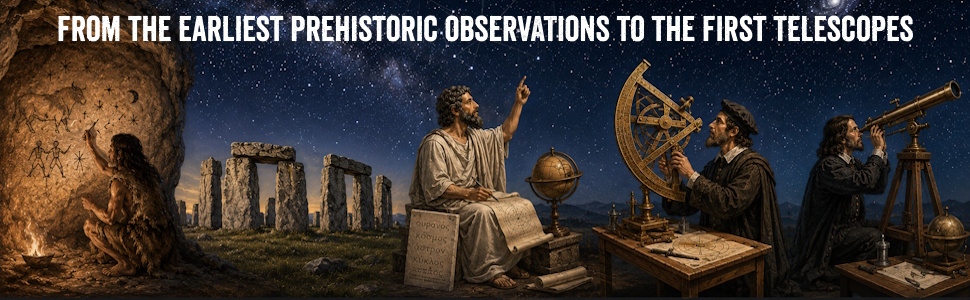
For thousands of years, long before the telescope, human beings studied the skies with remarkable precision and imagination. Astronomy from the Beginning ties in with the prehistory books and traces the history of astronomy from the Upper Palaeolithic to the Scientific Revolution. It explores how ancient cultures observed and interpreted the heavens. From Stonehenge and possible Ice Age constellations in cave art to the advanced astronomy of the Babylonians, Egyptians, Indians, Chinese, Maya, and Greeks, it describes how careful observation produced calendars, eclipse predictions, and methods of navigation. The book follows early attempts to explain the cosmos, from Ptolemy’s intricate model of the universe to the innovations of Islamic Golden Age scholars, whose work helped lay the foundations of modern science. It concludes with the discoveries of Copernicus, Kepler, Galileo, and Newton, which transformed humanity’s understanding of the universe.
A Short Guide to the Planets is a series of short reads that take us on a tour of the Solar System as we have come to understand it through centuries of observation, culminating in the robotic probes of the Space Age.
