THE “IN SEARCH OF” SHORT READS

The In Search of series of twelve 12,000-word short read eBooks are a follow-up to my full-sized works Humans: from the Beginning, Prehistoric Investigations, and Astronomy: from the Beginning. They are available either individually or in the Prehistoric Investigations 2 omnibus.

THE FIRST HOMININS

Cover image: The original complete skull (without upper teeth and mandible) of a 2.1 million years old Australopithecus africanus specimen so-called "Mrs. Ples" (catalogue number STS 5, Sterkfontein cave, hominid fossil number 5), discovered in South Africa. Collection of the Transvaal Museum, Northern Flagship Institute, Pretoria, South Africa.

Webpage available at: https://commons.wikimedia.org/wiki/File:Mrs_Ples_Face.jpg

Licence: Creative Commons Attribution-Share Alike 4.0 International license

Image credit: José Braga and Didier Descouens

Before the first humans came the age of the australopithecines – apes that walked upright like humans, but with brains no larger than those of chimpanzees.

HOMO ERECTUS

Cover image: 300,000 to 600,000 YA. The Homo erectus skull Peking Man is also known as Pithecanthropus pekinensis (Sinanthropus). The gray coloration indicates areas that were sculpted based on the original fragments. This scan was made as a collaborative effort between The Ohio State University Department of Anthropology, the Office of Distance Education and eLearning, and the Department of Art.

Captured with a Canon EOS camera array and processed/edited in Agisoft Photoscan.

This scan was produced in 2017 the 3D scanning lab, created and run by Andrew Frueh, in the Department of Art at The Ohio State University.

3d model available at: https://sketchfab.com/3d-models/homo-erectus-skull-d645e45ff307403e9d2073a6390fc353

Licence: Creative Commons Attribution-Share Alike 4.0 International license

Image credit: Andrew Frueh

In the late nineteenth century, Dutch anthropologist Eugène Dubois found the first example of an extinct human that had lived significantly before Homo sapiens.

THE ACHEULEAN HAND AXE
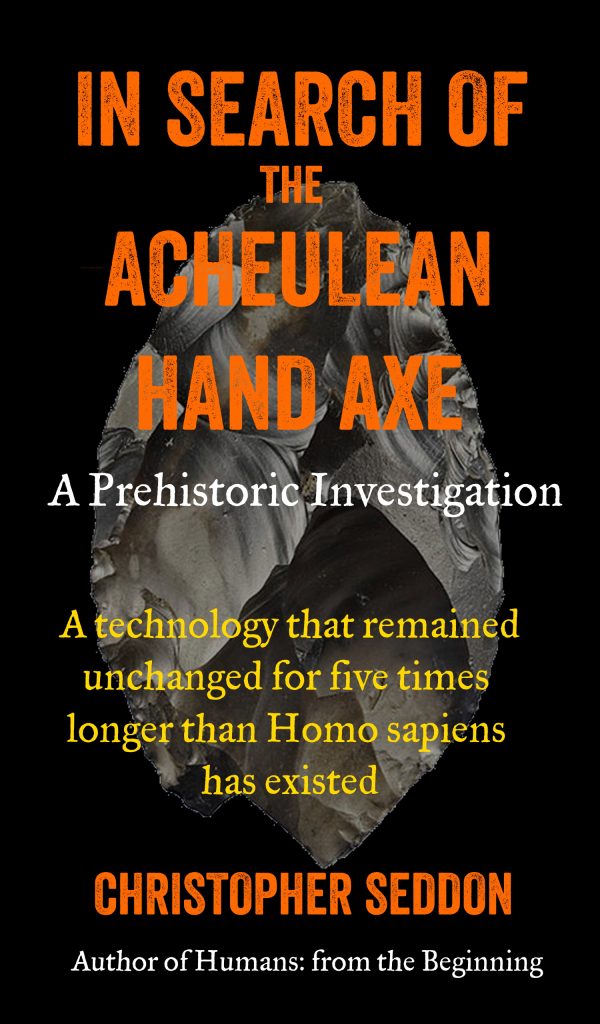
Cover image: NMS-ECAA52 A Palaeolithic hand axe (2012)

Webpage available at: http://finds.org.uk/database/artefacts/record/id/512140

Licence: CC by Share Alike

Palaeolithic handaxe. Ovate handaxe in mint condition but with a small thermal (frost) fracture at the butt end. Black flint with pale grey coarse grained inclusions, including a large one at the butt end, probably responsible for the v-shaped thermal (frost) fractured break. One face carries two small areas of fine grey pebble cortex. All flake removals are hard hammer struck. Dimensions 128 x 79 x 37mm.

This has become known as The Happisburgh hand axe. It was the first beach find to be recovered from a dateable context (circa 550,000 BC) in this area. Later excavations by AHOB found evidence of earlier activity, attributed to Homo Antecessor, that pushed back the earliest ancient occupation of Britain a further 450,000 to 350,000 years from the previously earliest site at Boxgrove (circa. 500,000 BC).

Image credit: Norfolk County Council

A multifunction tool that remained in use, more or less unchanged, for 1,750,000 years.

PILTDOWN MAN

Cover image: A reconstruction of the Piltdown Man skull - J. Arthur Thomson, The Outline of Science (1922)

Webpage available at: https://en.wikipedia.org/wiki/Piltdown_Man#/media/File:Piltdown_man.jpg

Licence: Project Gutenberg

Image credit: J. Arthur Thomson

The story of the most notorious hoax in the history of palaeoanthropology.

HOMO HEIDELBERGENSIS

Cover image: First description of Homo heidelbergensis: type specimen from Mauer (near Heidelberg, Germany); original condition with adherent material.

Source:Otto Schoetensack: Der Unterkiefer des Homo Heidelbergensis aus den Sanden von Mauer bei Heidelberg. Ein Beitrag zur Paläontologie des Menschen. Leipzig, 1908, Verlag von Wilhelm Engelmann.


Image available at: https://commons.wikimedia.org/wiki/File:Homo_heidelbergensis_(Erstbeschreibung)_02.jpg


Licence: Public domain

This work is in the public domain in its country of origin and other countries and areas where the copyright term is the author's life plus 70 years or fewer.

This work is in the public domain in its country of origin and other countries and areas where the copyright term is the author's life plus 71 to 100 years. These countries are Mexico (100 years), Jamaica (95 years), Colombia (80 years), Guatemala and Samoa (75 years), Côte d'Ivoire (99 years), and Honduras (75) years.

This work is in the public domain in the United States because it was published (or registered with the U.S. Copyright Office) before January 1, 1927.


Image credit: Otto Karl Friedrich Schoetensack (1850-1912)

How Homo sapiens emerged into a world shared with Neanderthals, Denisovans, and ‘hobbits’.

THE FIRST USE OF FIRE

Cover image: Large Bonfire (2004)

Webpage available at: https://en.wikipedia.org/wiki/File:Large_bonfire.jpg

Licence: Creative Commons Attribution-Share Alike 3.0 Unported license

Image credit: Fir0002

Darwin described the discovery of fire as “probably the greatest, excepting language, ever made by man” – but how was it made?

NEANDERTHALS

Cover image: A three-dimensional reconstruction of a typical Neanderthal skull.

The term has been used in a negative context for decades, but why do Neanderthals get such a bad rap?

EARLY FUNERARY PRACTICES

Cover image: West Kennet Long Barrow, an Early Neolithic chambered long barrow near Avebury, Wiltshire, dating to around 3700 BCE. Photo taken by the author on 11 October 2022.

Mourning and remembering the dead is a very ancient part of the human condition, but it may not be confined to modern or even archaic humans.

HOMO SAPIENS

Cover image: Leonardo da Vinci: The Proportions of the Human Figure (Vitruvian Manek) (1490; Pen, ink and watercolour over metalpoint).


Image available at: https://commons.wikimedia.org/wiki/File:Leonardo_da_Vinci-_Vitruvian_Man.JPG


Licence: Public domain

This is a faithful photographic reproduction of a two-dimensional, public domain work of art. The work of art itself is in the public domain for the following reason:

This work is in the public domain in its country of origin and other countries and areas where the copyright term is the author's life plus 100 years or fewer.

The official position taken by the Wikimedia Foundation is that "faithful reproductions of two-dimensional public domain works of art are public domain".

This photographic reproduction is therefore also considered to be in the public domain in the United States.

How our understanding of human origins has developed over the centuries, from the Great Chain of Being to modern theories.

PREHISTORIC ART

Cover image: Ochre stone found at the Blombos cave site. The pattern dates from approximately 70,000 years ago.

Webpage available at: https://commons.wikimedia.org/wiki/File:Blombo.jpg

Licence: Creative Commons Attribution-Share Alike 4.0 International license

Image credit: Chris S. Henshilwood

The discovery of the first cave art shattered nineteenth-century perceptions that the people of that era were primitive savages.

EARLY SEAFARERS

Cover image: artist's impression of one of the Early Bronze Age boats found at North Ferriby, Yorkshire.

The oldest-known boats are only around 12,000 years old, but seafaring could predate the emergence of modern humans.

EARLY METALLURY
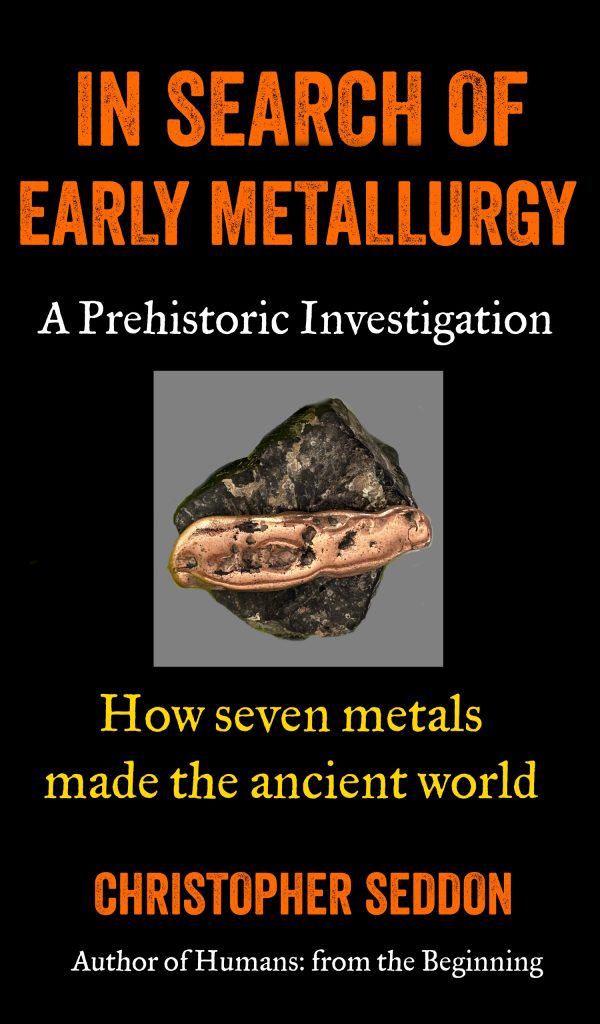
Cover image: Nugget of native copper owned by the author.

For most of their existence, humans made tools from stone and bone. How did they learn about copper, bronze, and iron?

Scroll to Top